Best trading journal by trader type
The table above is the short version. If you searched for a specific profile, here is the honest pick for each — including the cases where GridTrade is not it.
Best trading journal for beginners
Start with whatever you will actually fill in every day. For a complete beginner that is either a simple spreadsheet template (free, teaches you what each metric means) or GridTrade on the 14-day trial if you want R-multiple, win rate and expectancy calculated for you from trade one. The mistake beginners make is buying a feature-heavy journal, logging for two weeks, and quitting. Pick the tool with the least friction, log every trade with an emotion score, and review weekly — that habit matters far more than the software.
Best trading journal for day traders
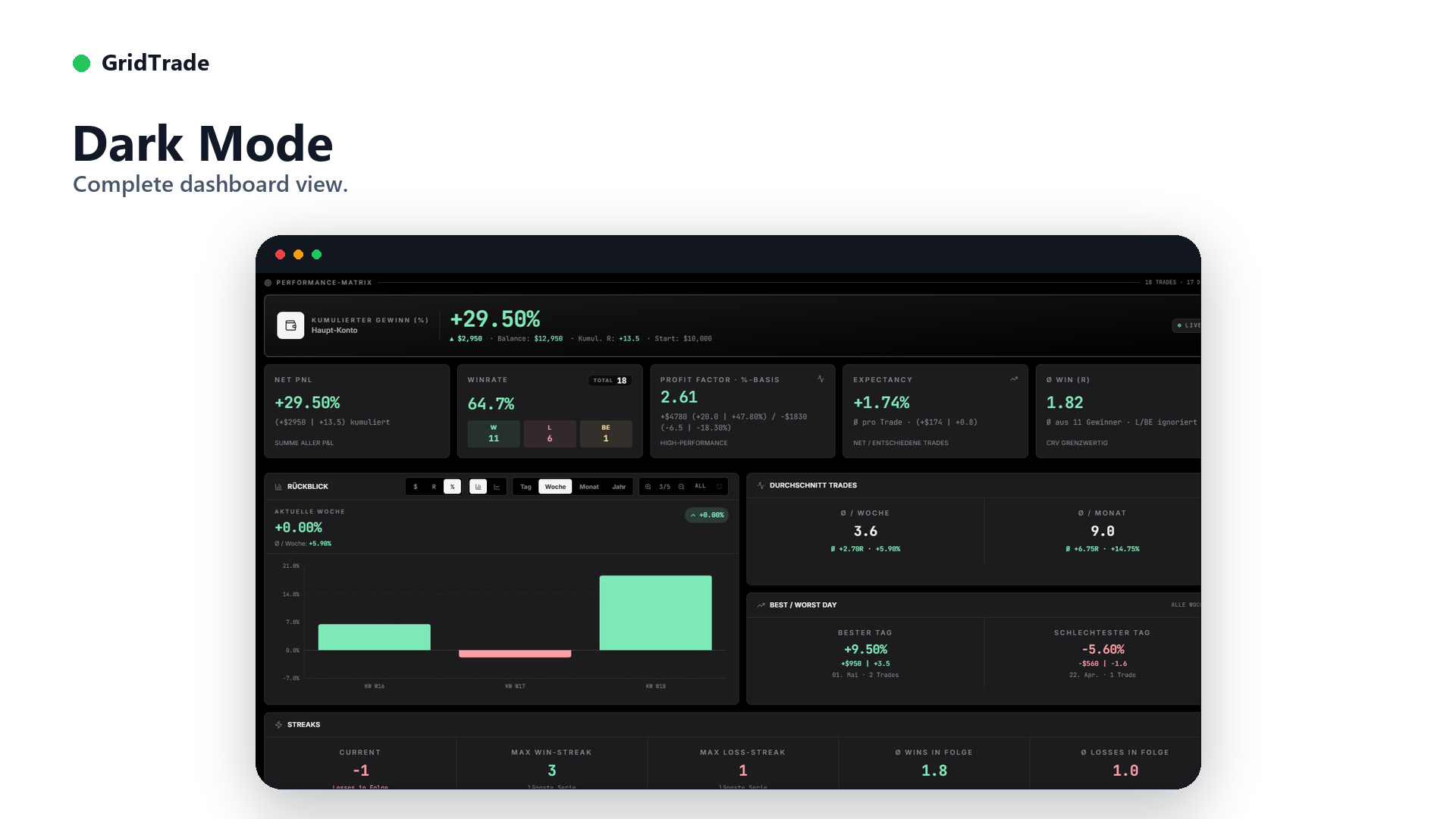
Day traders log many trades and need fast entry, a P&L calendar to spot red-day clusters, and filters by session and setup. GridTrade is built around exactly that workflow (calendar, 9 combinable filters, emotion per trade, EUR 24.99/mo flat). If you trade hundreds of US equity fills a day and manual entry is unrealistic, Tradervue’s broker auto-import is the stronger fit — see our GridTrade vs Tradervue comparison.
Best trading journal for swing traders
Swing traders take fewer trades, so per-trade depth matters more than entry speed: setup notes, thesis, screenshots, and how the trade was managed over days. Edgewonk’s statistical depth and one-time license suit that style well, and a spreadsheet remains perfectly viable at low trade counts. GridTrade works for swing trading too (R-multiple normalizes a 3-day hold against a 3-minute scalp), but its edge — emotion tracking under pressure and multi-account prop-firm rules — matters most to active intraday traders.
Best trading journal for prop firm traders
If you run FTMO, Apex, Topstep, FundingPips or FundedNext accounts, you need each account tracked separately with its own drawdown and daily-loss context, and you need to see the challenge-phase vs funded-phase gap in your own behavior. That is the one category where GridTrade is purpose-built rather than merely capable — start at the funded-account journal page, or jump straight to the FTMO, Apex or Topstep pages.
Best trading journal for futures traders
Futures journaling lives or dies on contract handling: NQ vs MNQ, ES vs MES, tick values, and dollar P&L that lies when you mix micros and minis. A journal that normalizes everything to R-multiple and has tick values pre-loaded saves you the spreadsheet formulas. See the dedicated futures trading journal page for the full picture, including which prop firms most futures traders run.
Best trading journal for forex traders
For forex the equivalent problem is pips and lot sizes across pairs with different pip values, plus session structure (London, New York) that a good journal should let you filter by. Edgewonk has deep forex roots; GridTrade adds per-trade emotion and multi-account challenge tracking for the FTMO/FundingPips crowd. The forex trading journal page walks through what to track and why.