The forex trading journal that tracks more than pips.
Pips lie to you. 30 pips on EURUSD and 30 pips on GBPJPY are not the same trade, and dollar PnL swings with lot size. What actually compares your London-killzone setups to your New-York ones is R-multiple — and what actually blows FTMO and FundingPips challenges is the revenge trade after a stop-out, not the setup. GridTrade is the forex journal built around both: normalized risk and tracked emotion.
€24.99/mo after trial · no credit card · cancel anytime
5 things a forex journal has to do differently
1. R-multiple, auto-calculated — because pip values lie across pairs
Forex trades in pips and lots, not shares — and pip value changes per pair, so raw dollar PnL is misleading the moment you trade more than EURUSD. Enter entry, stop, and lot size once; GridTrade computes the R-multiple automatically. A +2R on a 15-pip GBPUSD scalp and a +2R on an 80-pip USDJPY swing finally sit on the same scale.
2. Session structure — London, New York, Asia are different games
The London and New York killzones, the Asia range, the overlap — every forex setup has sessions where it works and sessions where it bleeds. Tag each trade with its session and pair, then filter: your win rate on London-open breakouts vs the same setup taken in the New York afternoon is usually the fastest leak you'll ever find.
3. Multi-account per prop firm — the retail-forex reality
Most serious retail forex traders don't trade one personal account — they run challenges at FTMO, FundingPips, The5ers, FundedNext, or E8 Markets, often several in parallel. Each firm is its own account in GridTrade with its own daily-loss and max-drawdown context, plus combined analytics across all of them. Multi-account is in the base tier, not a Pro gate.
4. Emotion 1-5 — the field that saves challenges
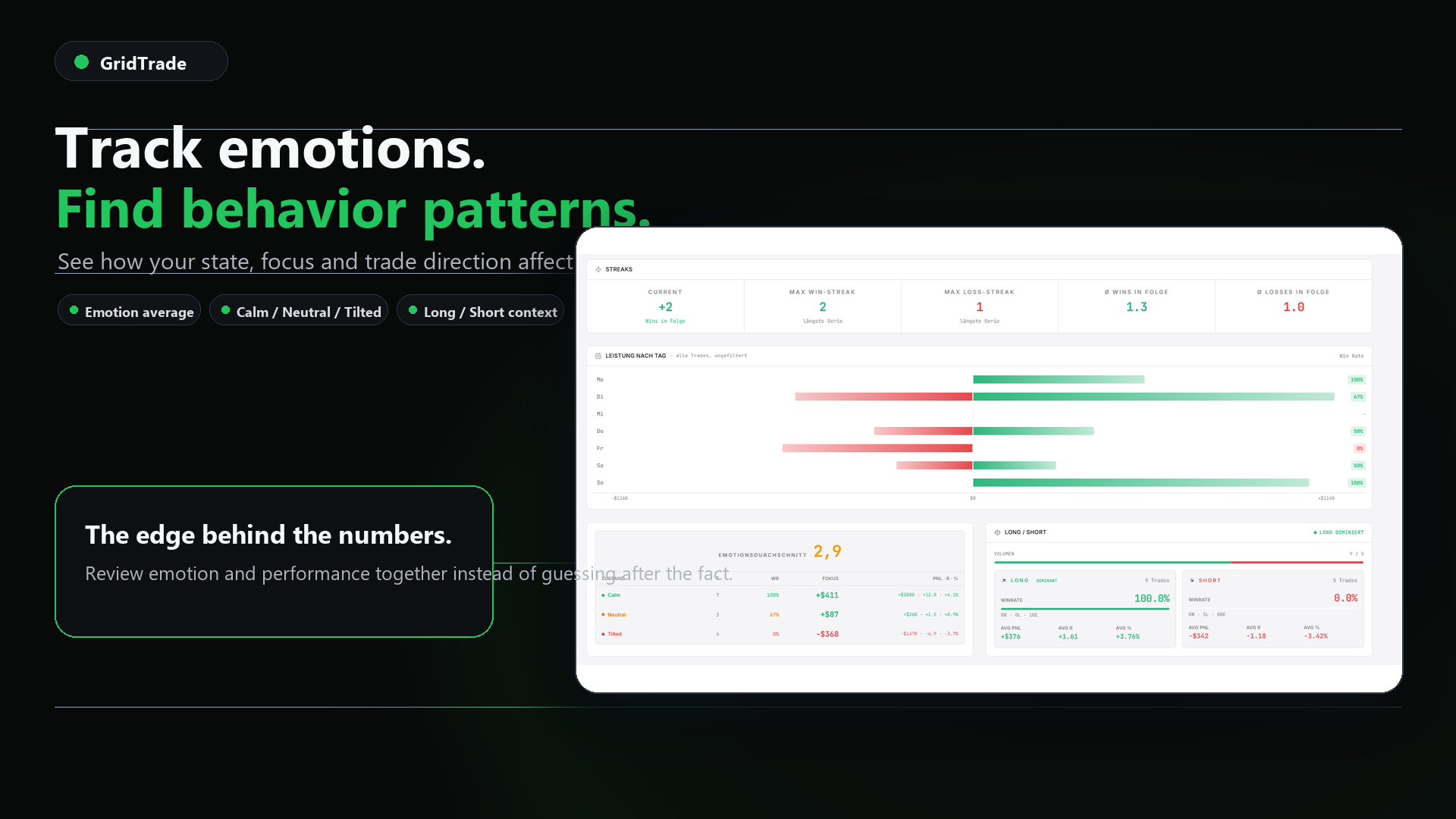
The trade that breaches a daily drawdown limit is rarely the first stop-out — it's the revenge entry ninety seconds after a stopped-out EURUSD trade. Score every trade 1-5 on emotional state, then look at win rate by score. Most traders find a 20-30% drop at high emotion. Here's how to track it.
5. Setup playbook — ICT, SMC, ORB with live expectancy
Define the setups you actually trade — fair-value-gap entries, order blocks, opening-range breakouts, whatever your model is — and tag every trade with one. GridTrade computes live win rate and expectancy per setup. Most forex traders discover one of their favorite models is negative-expectancy, and cutting it is the fastest path to passing a challenge.
Trading a forex prop challenge?
Each forex prop firm has different rules and pain points. We have a dedicated journal page per major firm:
For FTMO Challenge / Verification / Funded — daily 5% loss, 10% max, manual review.
For FundingPips evaluations — tight daily drawdown, fast-paced two-step model.
For The5ers bootcamp and high-stakes programs — scaling plan, static drawdown.
For FundedNext Express and Evaluation models — consistency rules, profit share from phase 1.
For E8 Markets evaluations — flexible account sizes, trailing and static drawdown options.
The multi-firm hub — running futures and forex challenges side by side in one journal.
FAQ — forex trade journaling
A forex trading journal should capture, for every trade, the pair, direction, entry, stop, target, lot size, and the session it was taken in — London, New York, or Asia — because the same setup behaves very differently at 3am than during the London-New York overlap. It should record risk in R-multiple, not just pips, since 30 pips on EURUSD and 30 pips on GBPJPY are completely different outcomes in money terms. Beyond the numbers, it needs the context a broker statement never shows: which setup from your playbook the trade belonged to, an emotion score from 1 to 5, and any mistake tag like a moved stop or a revenge entry. Finally, if you trade prop-firm capital, it should tie each trade to the specific account and its drawdown rules. That combination — mechanics, psychology, and rule context — is what turns a simple log into an edge-finding tool. If you want the exact fields, see our trading journal template.
Journaling in R means expressing every result as a multiple of the amount you risked, instead of pips or dollars. Before entry you define 1R: the distance from entry to stop, multiplied by pip value and lot size. A trade that risks 25 pips on EURUSD with a stop-loss worth €200 has 1R equal to €200; if it closes €400 in profit, it is a +2R trade, and a full stop-out is -1R. The power of this is normalization: a 15-pip scalp on GBPUSD and an 80-pip swing on USDJPY become directly comparable, because both are measured against their own planned risk. In GridTrade you enter entry, stop, and size once and the R-multiple is calculated automatically for every trade, so your statistics — expectancy, average winner, average loser — are always in R without any spreadsheet work.
The best forex journal for prop-firm challenges is one that treats multi-account tracking, drawdown awareness, and psychology as core features rather than add-ons, because challenges are lost to rule breaches and tilt far more often than to bad setups. You want each challenge — an FTMO Phase 1, a FundingPips evaluation, a FundedNext account — as its own account with its own daily-loss and maximum-drawdown context, plus combined statistics across all of them. You also want a structured emotion score on every trade, since the trade that breaches a daily limit is usually the revenge entry after a stop-out, not the first loss itself. GridTrade was built around exactly this workflow: unlimited accounts in the base tier, a daily-PnL calendar per account, emotion 1-5 on every trade, and R-multiple analytics, at a flat €24.99 per month with a 14-day trial and no credit card required.
Yes — every live trade, including the embarrassing ones, because selective journaling produces flattering but useless statistics. The trades you are most tempted to skip — the impulse entry during news, the revenge trade after a stopped-out EURUSD position, the oversized London-open punt — are precisely the ones that carry the information you need. If you only log your clean playbook setups, your win rate and expectancy describe a trader who does not exist. That said, journaling every trade does not mean writing an essay every time: a disciplined minimum is pair, session, setup tag, R-result, emotion 1-5, and one honest sentence, which takes under a minute on a phone. Demo trades and backtests can live in a separate account so they never contaminate your live statistics. The rule of thumb: if real money moved, the trade goes in the journal — no exceptions, and no editing after the fact.
Yes. In GridTrade each prop firm is simply a separate account inside one journal, so an FTMO Challenge, a FundingPips evaluation, a The5ers account, and your personal broker account all live side by side. You switch between them with one click, and every account keeps its own statistics, daily-PnL calendar, and drawdown context, because a static-drawdown account and a scaling account should never be measured on the same yardstick. At the same time, combined analytics run across all accounts, which is where the interesting questions live: whether your FundingPips trades are more disciplined than your FTMO trades, or whether one firm's rules push you into overtrading. There is no per-account pricing — multi-account is part of the flat €24.99 tier, which matters because serious forex traders usually run several challenges in parallel to diversify payout risk across firms.
Legal & Trademark Notice
Trademarks: “FTMO”, “FundingPips”, “The5ers”, “FundedNext”, “E8 Markets” and other prop-firm names are trademarks of their respective owners. GridTrade is not affiliated with, endorsed by, sponsored by, or in any way officially connected to any of these companies. References are made under the right of comparative advertising (German UWG § 6 / EU Directive 2006/114/EC) to describe compatibility with their publicly known rules.
Disclaimer: GridTrade is a journal/analytics tool. It does not provide trading signals, financial advice, or guarantees of success in any prop firm program. Trading carries substantial risk. Always verify current prop-firm rules on the respective firm's official website before relying on any specific rule reference made on this page.
Last reviewed: 2026-09-02. · Operated by Fabian Lehmann (see Impressum).
Built around how forex traders actually work.
14 days free, no credit card. €24.99/mo after — every pair, every session, every prop firm in one journal.
Continue reading
Related guides and pages — same niche, different angle.