The futures trading journal built for NQ & ES traders.
Futures journaling isn't stock journaling with different tickers. You trade contracts and tick values, not shares. You mix micros and minis, so raw dollar P&L lies to you. You live inside the first 90 minutes of the US session, and most likely you're trading someone else's capital under a daily loss limit and a trailing drawdown. GridTrade is the journal built around exactly that.
€24.99/mo after trial · no credit card · cancel anytime
5 reasons futures journaling is different
1. Contracts and tick values — not shares
A stock journal thinks in shares and price. Futures think in contracts and ticks: NQ moves $5 per tick, ES $12.50 per point, CL $10 per tick. GridTrade ships with the tick values for NQ/MNQ, ES/MES, RTY/M2K, YM/MYM, GC and CL pre-loaded — you pick the contract, enter your fills, and P&L, risk per contract and R-multiple are computed for you.
2. Micros vs minis make dollar P&L misleading — R-multiple fixes it
The same 40-tick win pays $200 on one MNQ and $2,000 on one NQ. Journal in raw dollars and the week you sized down to micros looks like a slump even if your execution was flawless. GridTrade normalizes every trade to its R-multiple, so expectancy and win rate stay comparable across contract sizes, accounts, and sizing phases. What is R-multiple →
3. Session timing — the US open is your whole day
Most futures day traders make or lose their day between 9:30 and 11:00 New York time. GridTrade tracks time-of-day per trade, so you can see your win rate in the first 30 minutes vs lunch chop — and whether your opening range breakout trades actually carry your ICT or pullback entries, or the other way around.
4. Prop-firm reality — daily loss limits and trailing drawdown
Most retail futures traders don't trade their own account — they trade Apex Evals, Topstep Combines, or MyFundedFutures accounts. That means every trade lives under a daily loss limit and a trailing drawdown. GridTrade tracks each funded account separately with its own rules, and the calendar PnL view shows how close each day came to the line that ends the account.
5. Emotion is the leak — especially after a stopped-out NQ trade
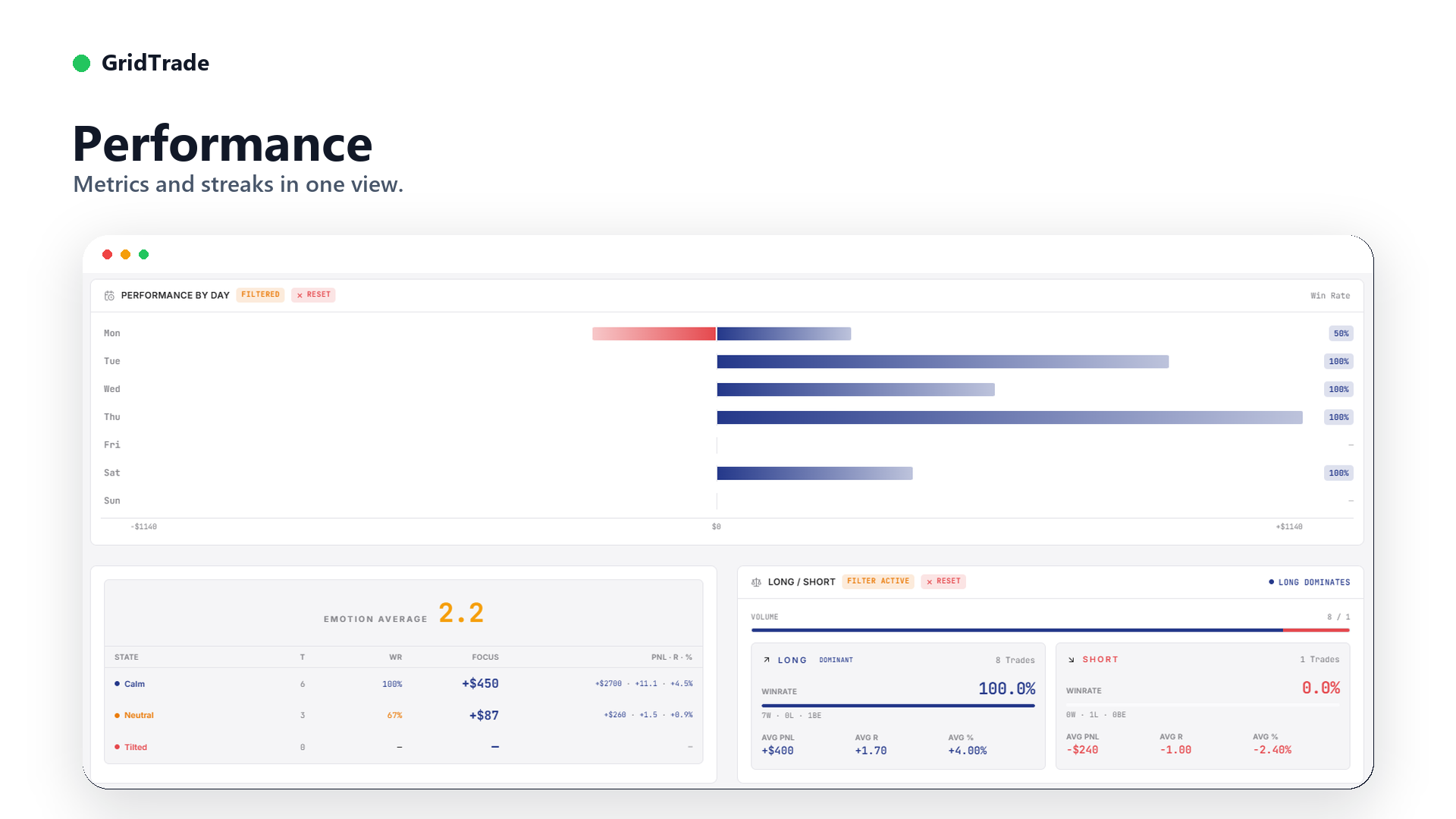
NQ moves fast enough that one stop-out can flip you into revenge mode within seconds. GridTrade makes emotion a structured 1-5 field on every trade, so you can filter your stats by emotional state and see the win-rate drop at emotion 4-5 in hard numbers. How to track emotions in trading →
Trading a funded futures account?
Each futures prop firm has different rules and pain points. We have a dedicated journal page per major firm:
For Apex Evals + PA accounts — trailing drawdown, up to 20 parallel Evals.
For Topstep Combine + Funded — daily loss limit, consistency rule.
For MFFU accounts — EOD vs intraday drawdown, buffer rules.
The multi-firm hub — run every Eval, Combine and funded account in one journal.
FAQ — futures journaling
A futures trading journal should track everything a stock journal tracks, plus the futures-specific context that actually explains your results. Per trade: the contract (NQ, MNQ, ES, MES, CL, GC), number of contracts, direction, entry, exit, stop distance in ticks, and dollar P&L derived from tick value. On top of that it should compute the R-multiple, so a 40-tick win on one MNQ and a 40-tick win on two ES contracts can be compared on the same scale. Then the behavioral layer: the setup you traded (ORB, ICT model, pullback), your emotion on a 1-5 scale, the session window (US open, lunch, close), and any rule you broke. Finally, if you trade funded accounts, each trade needs to be tied to a specific account with its own daily loss limit and trailing drawdown, because the same trade means different things under different rulesets.
Log the ticks and the R-multiple, not just the dollars. A mini contract like NQ moves $5 per tick while its micro MNQ moves $0.50, so two identical trades produce dollar P&Ls that differ by a factor of ten. If you journal raw dollars, the week you sized down to micros after a drawdown looks like your worst week of the year, even when your execution was your best. The fix is to record entry, stop, and exit in ticks, define your initial risk per trade, and let the journal express every result as an R-multiple. A +2R trade is a +2R trade whether it was one MES or five ES contracts. GridTrade stores the contract and quantity, so the dollar figure is still there for payout math, but expectancy, win rate, and setup statistics all run on R, which keeps micro and mini periods comparable.
Yes. GridTrade ships with the tick values and tick sizes of the common CME futures pre-loaded: NQ and MNQ, ES and MES, RTY and M2K, YM and MYM, plus GC and CL. When you log a trade you pick the contract and enter your fills; the journal already knows that one NQ tick is worth $5 and one MES tick $1.25, so dollar P&L, risk per contract, and R-multiple are computed for you instead of being one more spreadsheet formula to maintain. That matters most in the minutes right after a trade, when you want to log the emotion score and a one-line note in under a minute rather than doing tick math by hand. If you trade a contract that is not pre-loaded, you can still journal it — the pre-loaded list simply covers the instruments most futures day traders actually touch during the US session.
The honest answer: the one that treats funded accounts as the norm rather than an edge case, because that is how most retail futures traders operate today. Concretely, look for four things. First, native multi-account support, since firms like Apex explicitly allow many parallel Evals and serious traders run several. Second, per-account rule context — daily loss limits and trailing drawdown differ between Apex, Topstep, and MyFundedFutures, and your journal should frame each trade against the ruleset it was taken under. Third, structured emotion tracking, because revenge trading after a stopped-out NQ trade is what actually breaches accounts. Fourth, R-multiple analytics, so micro and mini periods stay comparable. GridTrade was built around exactly those four requirements, with a calendar PnL view on top and one flat price of €24.99 per month. Try it against your current tool for 14 days and let your own data decide. See also best trading journals 2026.
Yes, and this is the core of the product rather than a paid add-on. Each funded account — an Apex 50k Eval, a Topstep Combine, a MyFundedFutures account, plus your personal brokerage — lives as a separate account inside one journal. You switch between them with one click, and every trade is tagged to the account it was taken on, so per-account statistics never blur together. At the same time, the combined view shows your performance as a trader across all of them: overall expectancy, win rate by setup, and emotion patterns that repeat regardless of which firm's capital you are trading. There is no per-account pricing, so running five Evals costs the same €24.99 per month as running one. If one firm changes its rules or shuts down, you archive that account and your history stays intact — the journal outlives any single funded account.
Legal & Trademark Notice
Trademarks: Prop-firm names mentioned on this page — including “Apex Trader Funding”, “Topstep” and “MyFundedFutures” — are trademarks of their respective owners. GridTrade is not affiliated with, endorsed by, sponsored by, or in any way officially connected to any of these companies. References are made under the right of comparative advertising (German UWG § 6 / EU Directive 2006/114/EC) to describe compatibility with their publicly known rules.
Disclaimer: GridTrade is a journal/analytics tool. It does not provide trading signals, financial advice, or guarantees of success in any prop firm program. Trading futures carries substantial risk. Always verify current contract specifications and prop-firm rules on the respective official website before relying on any specific reference made on this page.
Last reviewed: 2026-09-02. · Operated by Fabian Lehmann (see Impressum).
Built around how futures day traders actually work.
14 days free, no credit card. €24.99/mo after — tick values, R-multiple and multi-account included.
Continue reading
Related guides and pages — same niche, different angle.