The trading plan template that traders actually follow.
A trading plan is the written set of rules around your strategy: which markets you trade, which sessions, how much you risk per trade and per day, which setups qualify, how you execute, when emotions force you to stop, and how you review. The strategy is one section. The plan is everything that keeps it alive.
Trading plan vs. trading strategy
Most traders who say they have a plan actually have a strategy: a pattern, an entry, a stop, a target. That's necessary and it's not enough. A strategy that backtests fine still loses money live when there are no rules around it — you oversize after a loss, you trade outside the session it works in, you keep going after the day is already red.
The plan is the layer above the strategy. It answers the questions the strategy doesn't: where, when, how much, how many, what to do when it goes wrong, and how to check whether it's working. Every one of those is a place a trade can go off the rails. So every one of them gets a section.
The trading plan template: 8 sections
Each section below has a heading and a note on what to write. The example answers are deliberately specific — vague rules aren't rules, because you can argue with them mid-trade.
Name the exact symbols you trade and nothing else. Example: "NQ and ES only. No forex, no crypto, no earnings plays." Everything not listed is off-plan by definition.
The time windows you're allowed to be active. Example: "New York open killzone, 9:30–11:00 ET. Flat by 11:00. No lunch trades, no after-hours."
Three numbers: risk per trade, daily loss cap, max trades per day. Example: "0.5% per trade. Stop for the day at −1.5% or after 3 trades, whichever comes first." Express results in R-multiples so the numbers hold as the account changes.
Two or three named setups, each with entry trigger, invalidation, and target. Example: "ORB long — entry on 5-min close above opening range high; invalidation below range midpoint; target 2R." If a trade doesn't match a name here, it's not a trade.
How you get in and out. Example: "Wait for the candle close, never market-in mid-bar. No chasing more than 5 points past the trigger. Never add to a losing position. Stop placed before the entry fills."
When your state — not the chart — takes you out. Example: "Rate emotion 1–5 before every entry. At 4 or 5, close the platform. After 2 consecutive losses, 20-minute break away from the screen." This is the section that stops revenge trading.
Copy the firm's limits and make yours tighter. Example: "FTMO daily loss 5% — my cap is 2%. Trailing drawdown 10% — I stop new trades at 6%." See how to journal trades for FTMO and the guide to passing a prop-firm challenge.
Fixed times, fixed questions. Example: "Daily, 5 min: log every trade with setup, emotion, rule-break tag. Weekly, 30 min: adherence rate, expectancy per setup, worst mistake tag." Without this section, the plan is never updated and quietly stops matching reality.
Trading plan example: one page, filled in
Here's what a complete plan looks like when the blanks are filled. It's short on purpose — this is the version that gets reread before a session.
| Section | Rule | Journal field that checks it |
|---|---|---|
| Markets | NQ, ES only | Instrument |
| Sessions | NY open, 9:30–11:00 ET | Session / time |
| Risk per trade | 0.5% of account | Risk % |
| Daily loss cap | −1.5% or 3 trades | Daily P&L, trade count |
| Setups | ORB long/short, VWAP reclaim, failed breakout | Setup tag |
| Execution | Candle close, no chasing, no adding to losers | Rule-break tag |
| Emotional stop | Emotion ≥ 4 or 2 losses in a row | Emotion 1–5 |
| Prop-firm | Stop at 2% daily, 6% trailing | Drawdown from peak |
| Review | 5 min daily, 30 min weekly | Adherence rate |
The third column is the point most templates miss. A rule with no field that checks it is a wish. Every line in a plan should map to something you log — which is why the plan and the journal template need to be designed together.
The pre-trade checklist
The plan is what you write once. The checklist is what you run every single time, in the thirty seconds before the click. Eight yes/no questions — one "no" and the trade doesn't happen. Keep it visible next to the chart.
Are you trading with the direction of the 1-hour or 4-hour structure, or against it because the 1-minute chart looked exciting?
Check the clock against section 2. "Almost" the session is outside the session.
Not "it looks like" one. Say the setup's name and confirm the entry trigger from section 4 has actually printed.
Position size × stop distance ≤ your per-trade percentage. Do the math, don't estimate — oversizing is the most common rule break in every journal.
In the platform, at the invalidation level, before the entry fills. A mental stop is not a stop.
Rate yourself honestly. At 4 (frustrated, rushed, euphoric) or 5, section 6 says close the platform — this box overrides every other yes.
CPI, FOMC, NFP, or a scheduled speech will blow through your stop and your setup logic. Check the calendar, not your memory.
If you've hit −1.5% or your third trade, the answer is no regardless of how good this one looks. That's the whole point of a cap.
The checklist works because it moves the decision out of the moment. You're not asking whether the trade feels right — you're asking whether it passes eight facts. Any trade that skipped a question gets a rule-break tag in the journal, even if it won. Especially if it won.
How a journal enforces the plan
A plan you don't measure against is a plan you slowly stop following, and you won't notice because memory is generous. The journal is the enforcement layer, and it does it with three fields.
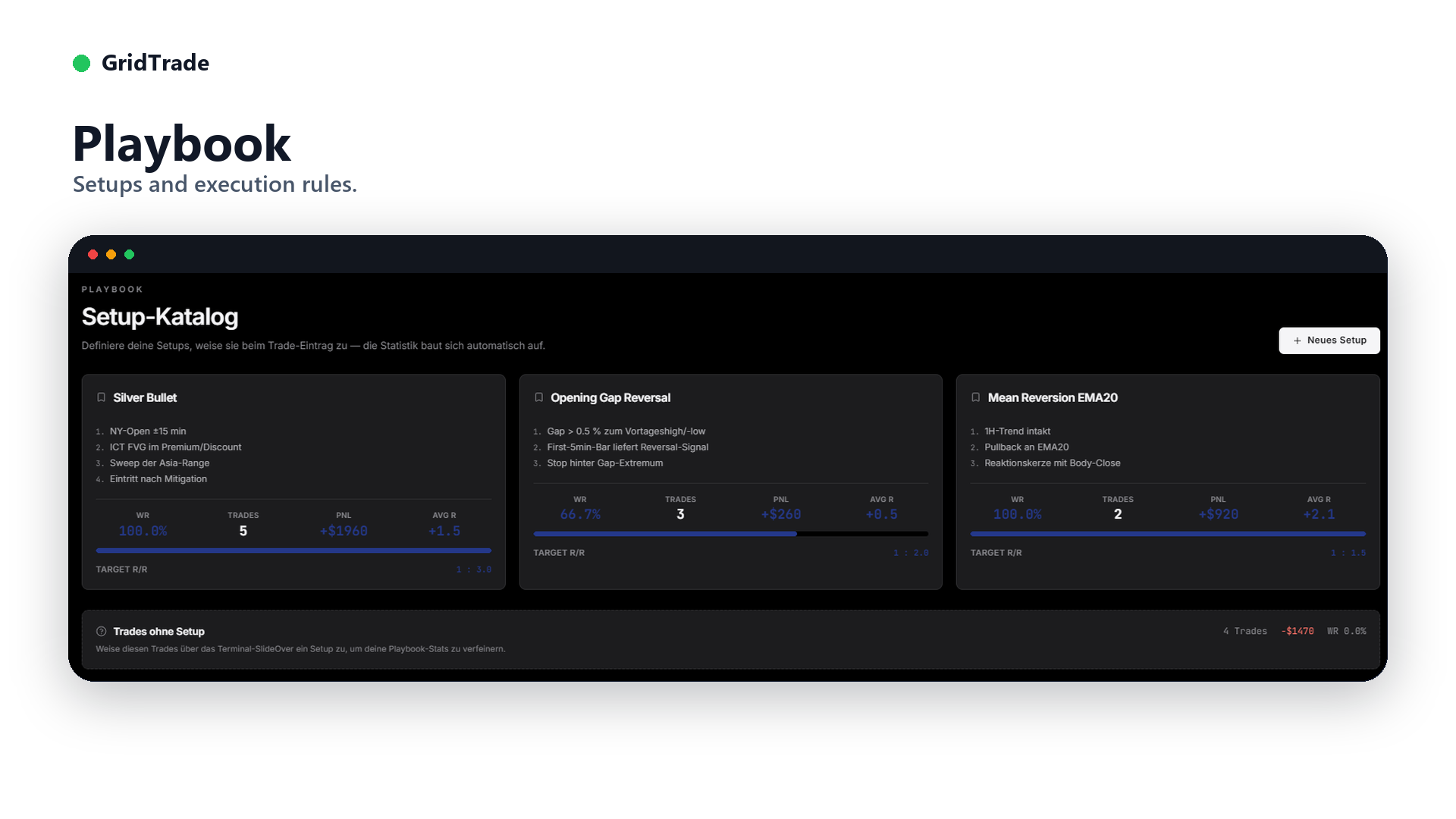
Setup tag. Every trade is logged against a named setup from section 4 — or tagged off-plan if it matches none. After a month, the playbook stats show you the win rate and expectancy of each setup separately. That's how you find out that "failed breakout" earns 0.4R per trade and "VWAP reclaim" loses 0.2R, and cut the loser from the plan with evidence instead of a feeling.
Rule-break tag. A fixed list that mirrors sections 3, 5 and 6: oversized, outside session, no stop, chased entry, added to loser, traded past cap. Any trade that failed a checklist question gets one. Three tags usually account for most of your red.
Adherence rate. This is the metric that predicts P&L better than win rate does. Split your trades into on-plan and off-plan and compare the two columns: in almost every journal, the on-plan trades are profitable and the off-plan trades carry the losses. When adherence goes up, the equity curve follows — and when it drops, that's your early warning long before a drawdown forces the question.
That's the loop: write the plan, run the checklist, log against the plan, review adherence weekly, edit the plan from the data. Terms you're unsure about are in the trading glossary.
FAQ
What should a trading plan include?
A complete trading plan covers eight sections. First, the markets and instruments you trade, named explicitly so everything else is off-limits. Second, the sessions or killzones you are allowed to be active in. Third, risk rules: percent risked per trade, a daily loss cap, and a maximum number of trades per day. Fourth, your setups, each with a name, an entry trigger, an invalidation level, and a target. Fifth, execution rules such as waiting for the candle close, never chasing, and never adding to a loser. Sixth, emotional rules that tell you when to stop, for example after three losses or when your emotion score hits four. Seventh, prop-firm rules if you trade a funded account. Eighth, a review routine: five minutes daily and thirty minutes weekly. If a section is missing, that is exactly where your undisciplined trades will come from.
What is the difference between a trading plan and a trading strategy?
A strategy is the setup: the specific pattern you trade, where you enter, where the stop goes, and where you take profit. It answers the question of what a valid trade looks like. A trading plan is the set of rules wrapped around that strategy. It defines which markets you apply the strategy to, which sessions you are allowed to trade, how much you risk per trade and per day, how many trades you may take, how you execute an entry, when emotions force you to stop, and how you review your results. A strategy can be profitable in a backtest and still lose money live because the plan around it is missing: the trader oversizes, trades outside the session, or keeps going after a loss cap. The strategy is one section of the plan. The plan is what makes the strategy survivable.
How detailed should a trading plan be?
Detailed enough that a stranger could read it and know whether a given trade was allowed, but short enough to fit on one page you can actually reread. The test is whether every rule is binary. "Trade only when the market is favourable" is not a rule because you can argue about it mid-trade. "Trade NQ only between 9:30 and 11:00 New York time, risking 0.5 percent, maximum three trades" is a rule because it is either followed or broken. Aim for two or three named setups rather than ten, one line each for entry, invalidation, and target. Most plans fail not because they are too vague but because they are too long: a twelve-page document is never opened once the session starts. Write the one-page version, print it, and keep it next to the screen. Expand a section only when your journal shows that section is where your rule breaks cluster.
What goes on a pre-trade checklist?
A pre-trade checklist is six to eight yes-or-no questions you answer before every entry, and a single no means you do not take the trade. A solid version reads: Is the higher-timeframe bias aligned with this direction? Am I inside my allowed session or killzone? Is this a named setup from my playbook, not something that merely looks similar? Is the risk at or below my plan's percentage? Is the stop-loss placed before I click? Is my emotion score three or lower? Is there high-impact news in the next fifteen minutes? Have I stayed under my daily loss cap and trade count? The checklist works because it moves the decision out of the moment. You are not asking whether the trade feels good, you are asking whether it passes eight facts. Keep it visible, keep it binary, and log every trade that skipped a question as a rule break.
How do I know if I'm actually following my trading plan?
You measure it, because memory is far too generous about this. Log every trade against a setup from your plan, and if the trade does not match any named setup, tag it as off-plan. Add a rule-break tag from a fixed list: oversized, outside session, no stop, chased entry, added to loser, traded past loss cap. Your adherence rate is simply the share of trades with no rule-break tag and a valid setup. Most traders who feel disciplined discover an adherence rate between fifty and seventy percent the first time they measure it. Then split the P&L: trades that followed the plan versus trades that broke it. In nearly every journal the on-plan trades are profitable and the off-plan trades carry most of the red. That single split is the strongest argument for the plan you will ever see, because it is your own data, not a coach telling you to be disciplined.
A journal that measures plan adherence for you.
GridTrade logs every trade against a named setup, tracks rule breaks and emotion on each entry, and shows win rate and expectancy per setup — so you see whether the plan is being followed and which parts of it are earning. €24.99/mo flat. 14-day free trial, no credit card.
Start free trial